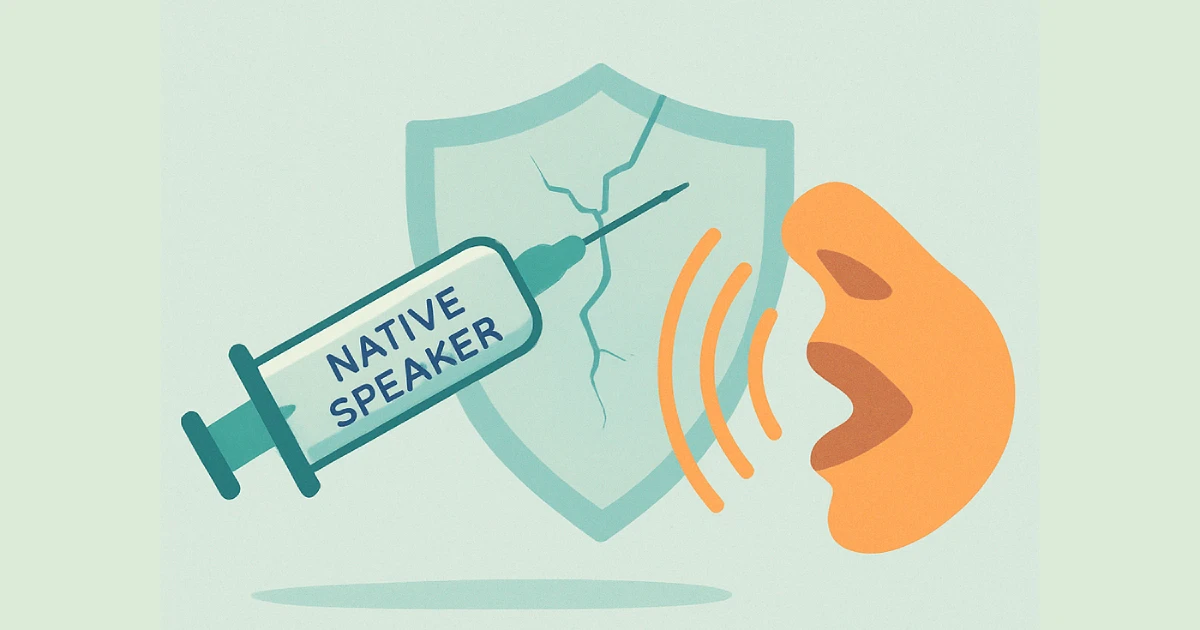
For a very long time, many language learners have incorrectly believed that the key to mastering pronunciation is having a native-speaking teacher. If you think about it, it sounds logical: if you want to sound like a native, learn from a native. But as pronunciation expert John Levis bluntly puts it:
“Native teachers can be stupid. They can be insistent that all you have to do is follow me.”
It’s a hard pill to swallow, but an important one: pronunciation isn’t about copying a native speaker, and being a native speaker doesn’t automatically make you a great teacher.
The Myth of the Native-Speaker Advantage
There’s a common assumption that native teachers have some kind of built-in advantage when teaching pronunciation. But is that really the case? Let’s break this down. A native speaker may pronounce words correctly (and what is correct varies depending on the region), but can they explain how they do it? The truth is, many can’t. That’s because speaking a language and teaching it are two completely different skills.
Think about it: most native English speakers don’t even know what a schwa is, yet it’s the most common sound in the language. They naturally use vowel reductions, connected speech, and stress patterns without ever having to think about them. But when a language learner struggles with a tricky sound, a native teacher might say, “Just say it like this.” Easy, right? Not really. Without understanding the mechanics behind it, that advice isn’t very useful.
Meanwhile, non-native teachers (or those who worked really hard to achieve a high level of proficiency in the language) often have an advantage in pronunciation instruction. Why? Because they’ve had to learn it themselves. They understand what it feels like to struggle with tricky sounds, and they’ve developed strategies to master them. They can break down pronunciation into step-by-step techniques, explain why certain sounds matter more than others, and guide learners toward intelligibility rather than perfection.
Intelligibility, Not Perfection
This is where John Levis’ work comes in. He coined the term “the intelligibility principle”, which shifts the focus from sounding native to being clearly understood. The reality is, you don’t need to sound like a native speaker to communicate effectively. In fact, research suggests that some pronunciation “mistakes” don’t even impact intelligibility that much.
For example, mispronouncing certain vowel sounds often doesn’t hinder understanding, while errors in word stress or rhythm can completely throw off a listener. Yet, many learners obsess over minor sound differences while ignoring the bigger-picture aspects of pronunciation that actually matter.
This is exactly what Levis discusses in the latest #TeacherTalkingTime podcast episode. In our conversation, we discuss:
🎙️ What the intelligibility principle really means for learners
🎙️ Why some vowel sounds aren’t as important as we think
🎙️ High-value vs. low-value pronunciation features
🎙️ The real impact of native vs. non-native teachers on pronunciation learning
Rethinking What Makes a Good Pronunciation Teacher
At the end of the day, a great pronunciation teacher isn’t necessarily a native speaker—it’s someone who understands phonetics, knows how to break pronunciation into practical steps, and gives targeted feedback that actually helps learners improve.
So if you’ve ever thought, “I need a native teacher for good pronunciation,” then this episode might just change your perspective.
📢 Listen to our full conversation with John Levis here: Native Teachers Can’t Fix Pronunciation – John Levis
What’s your take? Do native speakers have an advantage in teaching pronunciation, or is it just a myth?