“Success depends less on materials, techniques, and linguistic analyses, and more on what goes inside and between the people in the classroom.”
If you’ve been to a session on Dogme ELT, teaching unplugged, or reactive teaching, chances are you’ve heard this quote before. After all, it is present in every session, workshop, or it is often quoted by language teachers who subscribe to this mindset.
But have you ever really felt it?
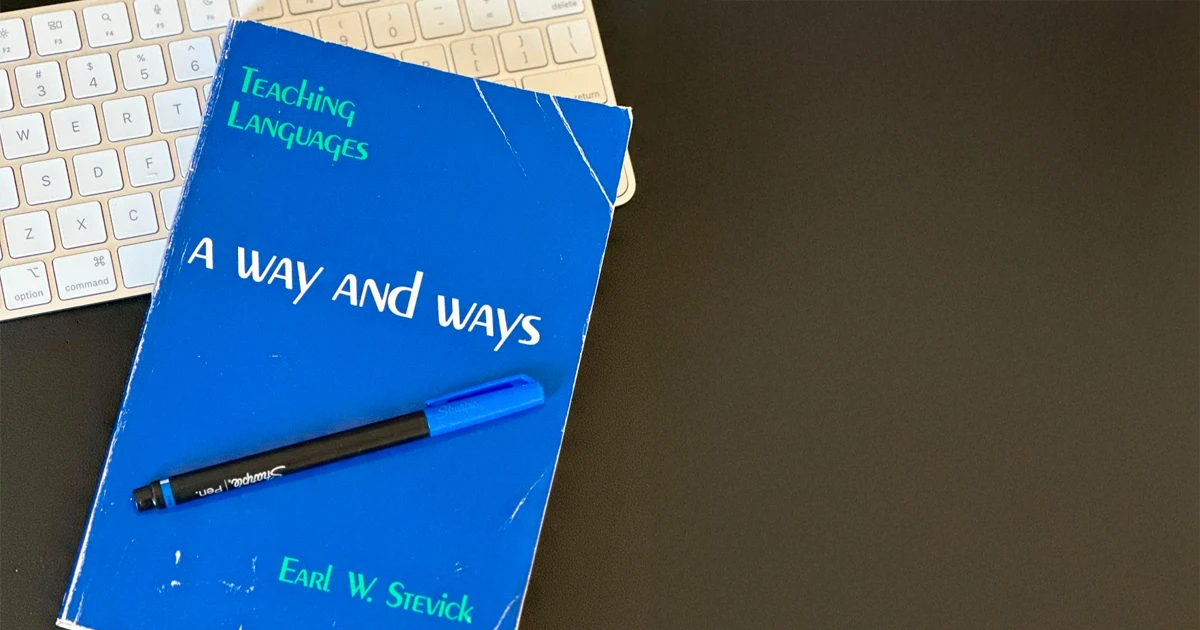
For me, that moment came not in a conference room, but in a thrift store – where I finally got my hands on a book I had been searching for over a decade. Imagine the feeling of stumbling upon a book you’ve wanted for 10+ years. That rush of excitement, that quiet disbelief. That was me when I found Earl Stevick’s book.
And let me tell you – it was worth the wait.
Beyond Methods: The Human Side of Teaching
Earl Stevick rewired the way we think about language classrooms. He pushed back against old-school, teacher-centered approaches that put all the weight on the instructor, the textbook, and a neat grammar analysis. Instead, he zeroed in on what really matters: memory, cognition, emotion, and, as he called it, “harmony”. In his words:
“Success depends less on materials, techniques, and linguistic analyses, and more on what goes inside and between the people in the classroom.” (Stevick, 1980, p.4)
What I like about Stevick’s book is that it isn’t just about language teaching methods. It’s about something much deeper: what actually makes learning stick. And spoiler alert – it’s not the perfect worksheet, the right materials or the perfect lesson plan.
He takes you inside real classrooms, not just outlining teaching theories but showing you how they play out in practice. You see his own choices as a teacher, the moments that worked, and the moments that didn’t. That level of honesty is still rare in language teaching books—and it’s exactly why his work endures.
Drawing on decades in front of students, Stevick confesses:
“My method usually consisted of thinking up a topic to talk about, introducing it, and encouraging each student to express their feelings.”
He then widens the lens, reminding us that
“… a language class is one arena in which a number of private universes intersect one another …”
And he drives the point home with a pledge that still resonates:
“… the need for a warm, humanistic learning climate caused me to become strongly committed to giving students plenty of latitude within which to develop their own inner resources.”
But what really stood out to me?
The biggest barriers to learning aren’t grammar rules or vocabulary lists. They’re internal:
- Fear of failure
- Anxiety about making mistakes
- Pressure of being evaluated
And that’s where human connection comes in.
Learning Is a Mental Game
Stevick argues that language learning is as much psychology as linguistics. Students must feel safe enough to take risks, experiment, and speak without fear of judgment.
We talk so much about how to teach – what activities to use, what techniques are most effective – but we don’t talk enough about how learners feel. And if students don’t feel safe, seen, and supported, even the best teaching methodologies fall flat.
Stevick writes not only as a teacher but as a learner. He openly shares his own frustrations with mastering new languages, making the book disarmingly personal – and relatable. How often do you hear a linguist or expert admit just how hard learning can be?
A Rare Find, A Powerful Reminder
Finding this book was more than just checking an item off my wishlist; it reminded me why I fell in love with teaching in the first place. Methods matter, but what happens inside and between people in the classroom matters more.
I can’t wait to keep reading.
What about you? Have you ever finally found a book you’ve been searching for? And if you’ve read Stevick, what are your thoughts?