
I never thought stepping away from digital distractions would lead me back to the kitchen.
But as I started enjoying cooking more, something clicked.
And I realized this while chopping onions last night (eyes watering from both the onions and the epiphany 😉):
Every great dish has a few essential ingredients.
And so does learning a new language.
To me, learning a new language is a lot like cooking a great dish.
You need the right ingredients, the right balance, and a bit of heat to bring everything together.
So … what’s the secret recipe for learning a language?
After 25 years of teaching, learning, and studying Second Language Acquisition (SLA), I’ve found (and research backs me up) that it boils down to 4 key ingredients—each one critical to building fluency and confidence.
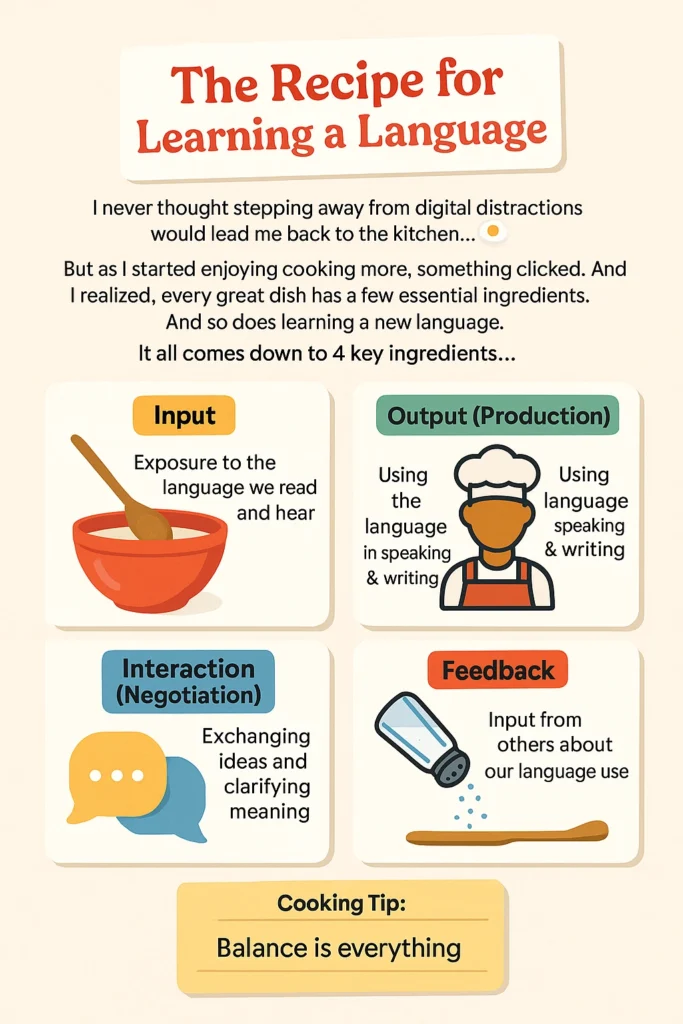
Let’s break them down one by one:
🥄 1) Output (Production)
This is what learners produce—what they say or write in the target language.
But here’s the thing: not all output is equally helpful.
Think of output like mixing your ingredients. If learners are just going through the motions (e.g., repeating phrases or filling in blanks), they’re not really cooking—they’re microwaving.
✅ What works best?
- Creative use of language
- Meaningful, communicative speech
- Expressing ideas and resolving challenges in real-life situations
It’s in the struggle to express themselves—find the right word, clarify a thought, or react to a conversation partner—that learners begin to refine their skills.
🍅 2) Input
Input is the language learners receive—what they hear, read, or watch in the target language.
This is the raw material of acquisition.
But it needs to be comprehensible. That means:
- Just challenging enough to stretch learners
- Not so difficult that it overwhelms them
If output is mixing the ingredients, input is choosing the right ones. Poor quality input? Poor quality results.
The more meaningful, contextualized, and rich the input, the more learners can absorb structures, vocabulary, and usage patterns—without needing to memorize them consciously.
🗣️ 3) Interactional Adjustment (Negotiation for Meaning)
Ever had a conversation where you had to pause, clarify, or rephrase what you were saying?
That’s negotiation for meaning—and it’s pure gold for language learning.
These moments are powerful because they:
- Create genuine opportunities to process language
- Help learners notice gaps in their own knowledge
- Push learners to restructure and adjust their language use
Think of this like adjusting the heat while cooking. When things aren’t quite right, you tweak the conditions—and that’s exactly what learners do in live conversation.
🧂 4) Corrective Feedback
Every great dish needs seasoning—and in SLA, that’s feedback.
Feedback helps learners:
- Notice errors
- Adjust their interlanguage
- Move toward greater accuracy and fluency
It can be explicit (e.g., “You need the past tense here”) or implicit (e.g., reformulating the error correctly). What matters most is that learners have the chance to act on it.
No seasoning = bland.
Too much = overpowering.
Balance is key.
🔄 Why It All Matters: It’s Not About a Single Ingredient
Each of these ingredients plays a distinct role:
- Input gives learners the material they need to acquire language
- Output allows them to experiment and test what they’ve internalized
- Interaction helps refine and clarify meaning
- Feedback guides and sharpens their use of language over time
But here’s the catch: No single ingredient is enough on its own.
You can’t expect a flavorful dish if all you use is salt—or if you forget to turn on the stove.
To Reflect: What’s in Your Language Recipe?
Whether you’re a teacher designing a lesson or a learner studying on your own, ask yourself:
- Am I giving myself (or my students) enough input before expecting output?
- Are there regular opportunities for real interaction—not just drills?
- Is feedback part of the process, and is it being used effectively?
- Is output meaningful and communicative, not just mechanical?
Language acquisition doesn’t happen with a single method or a magic ingredient. It’s the result of careful balance, attention, and consistent adjustment.
So, what does your current recipe look like?
Is it working? What might you need to stir in—or scale back?
I’d love to hear from you:
Which of these four ingredients do you focus on most in your teaching or learning? How do you strike the right balance?
References:
Gass, S., & Mackey, A. (2007). Input, interaction and output in second language acquisition. In B. VanPatten & J. Williams (Eds.), Theories in second language acquisition: An introduction (pp. 175–199). Mahwah, NJ: Lawrence Erlbaum.VanPatten, B., & Benati, A. G. (2010). Key terms in second language acquisition. London, UK: Continuum.