
Before I even go any further, I would like to clear up a common myth right from the start:
👉 Output alone does not build a learner’s language system.
In the field of Second Language Acquisition (SLA), output refers to the language that a learner produces—but it’s not just any language.
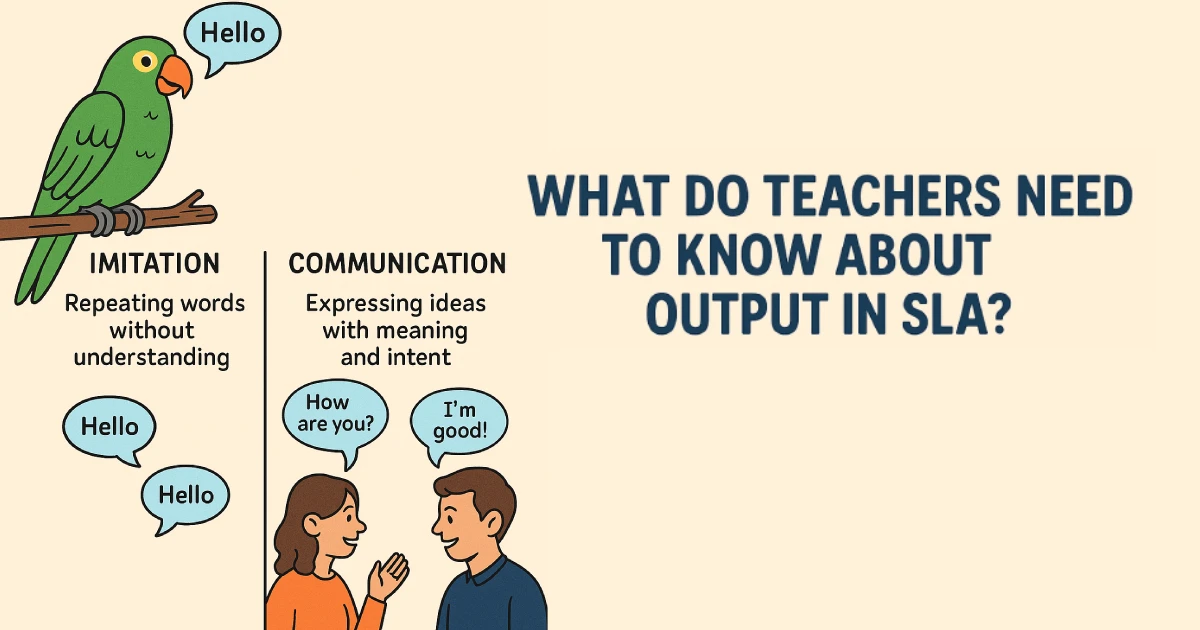
To truly count as output, the production must involve an intention to convey meaning.
Think about it this way: Parrots can mimic human speech quite well, but we don’t say that parrots speak in the human sense.
They imitate sounds without understanding the meaning behind them.
Similarly, if learners simply repeat phrases or recite sentences without intending to express meaning, that’s not real output either.
True output involves an effort to communicate—a deliberate attempt to make oneself understood by another person.
Let’s Set the Record Straight: Key Principles about Output in SLA
- Output helps learners access the system—but doesn’t build it.
In SLA, we understand that input—the language learners hear and read—is what actually builds the internal system. Output, on the other hand, helps learners practice retrieving and organizing the language they have already acquired. It’s about skill development, not system construction.
- No input = No output.
Simply asking students to “speak more” or “write more” won’t lead to better language ability if they haven’t first had enough comprehensible input. If learners haven’t heard enough examples of the target structures or vocabulary used naturally, they simply won’t have the material they need to produce language accurately or fluently.
- Not all production counts as output.
If a student is repeating words or phrases without any intention of expressing a message—like reading sentences aloud or repeating a dialogue mechanically—that’s not considered true communicative output. Real output must involve an attempt to communicate meaning.
- Mechanical exercises ≠ meaningful output.
Turning sentences from present to past tense? Rearranging words to form questions? These are practice activities, but they don’t necessarily lead to deeper language acquisition unless learners are trying to communicate something meaningful.
- Communicative output is key.
When learners express ideas, negotiate meaning, clarify misunderstandings, and respond to authentic prompts, they push themselves to notice gaps in their knowledge, reorganize what they know, and refine their skills.
What This Means for Teaching
The implications for language classrooms are huge. As teachers, we should be asking ourselves:
✅ Are we giving students enough input?
Before expecting output, we must ensure that learners have had rich exposure to language—through listening, reading, and meaningful interaction—so they have something to draw from when they produce language.
✅ Is our classroom output meaningful?
Are we designing activities that require real communication? Are students expressing ideas, solving problems, sharing opinions, or negotiating meaning? Or are they just doing drills and mechanical transformations?
✅ Are we prioritizing skill development over rote practice?
Instead of focusing on perfect grammar drills, we should be helping learners use language for real purposes, accepting that errors are part of the process of developing fluency and complexity over time.
The Bottom Line
Output refines, but input builds.
Meaningful communication matters more than mechanical accuracy.
Skill development is the goal—not perfection.
By shifting our focus away from simply pushing output for its own sake, and toward creating conditions for rich input and authentic communicative practice, we can help learners truly develop their language abilities.
How do you encourage meaningful output in your classroom? I’d love to hear your thoughts
References:
Swain, M. (1993). The output hypothesis: just speaking and writing aren’t enough. The Canadian Modern Language Review, 50(1), 158-164. https://doi.org/10.3138/cmlr.50.1.158
Liming, Y. (1990). The Comprehensible Output Hypothesis and Self-directed Learning: A Learner’s Perspective. TESL Canada Journal, 8(1), 09–26.
VanPatten, B. (2003). From input to output: A teacher’s guide to second language acquisition. McGraw-Hill